
Scoring the Blockade: Leverage vs Risk over Time
The least-worst option still isn’t good, and it gets worse over time.

4 May 2026
A blockade can sound clean when discussed in shorthand. It is not a ground invasion. It is not a renewed air campaign. It does not require amphibious options that would carry obvious military and escalation risk. Compared against the alternatives actually available, it may be the least-worst option.
But least-worst does not mean good.
That distinction matters. The United States has already demonstrated that it can strike targets and impose damage. The harder problem is that those strikes, however tactically successful, did not compel the Iranian government to accept Washington’s terms. Resuming strikes may create more damage, but not necessarily more leverage. Amphibious or ground options would add risk far beyond the blockade. So the blockade becomes the instrument that preserves pressure without immediately choosing the most dangerous military path. That is why it is attractive. It is also why it is dangerous.
The blockade began as a military instrument, but it does not stay in the military lane. The moment the United States starts controlling maritime traffic, it creates effects across diplomacy, information, economics, finance, intelligence, and law. Some of those effects create leverage. Others create risk. All of them compound the responsibility the United States has for this elective conflict. The key point is that those effects change over time.
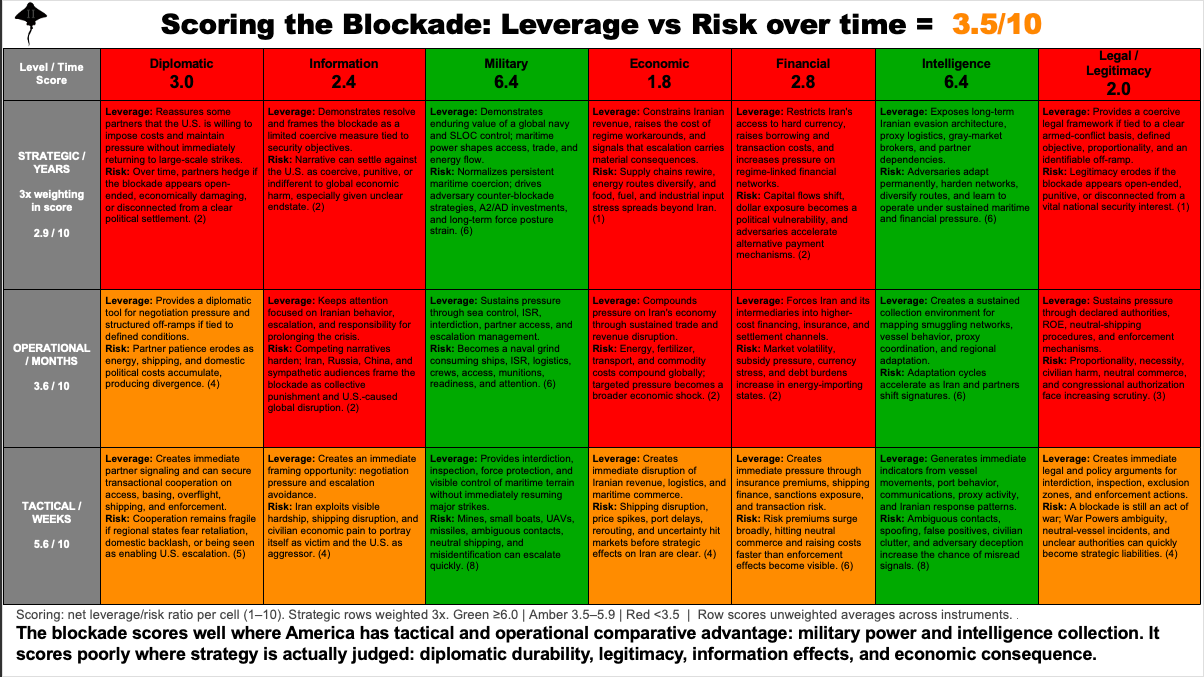
To add some rigor to my own thinking, I built the matrix below. It maps seven instruments of national power—Diplomatic, Information, Military, Economic, Financial, Intelligence, and Legal/Legitimacy—against three time horizons: Tactical (weeks), Operational (months), and Strategic (years). Each cell scores net leverage against risk on a 1–10 scale. Strategic rows are weighted 3x, reflecting that coercive instruments are ultimately judged against their ability to produce durable political outcomes, not near-term activity. Column scores are weighted composites. Row scores are unweighted averages across all seven instruments, giving a read on how the overall enterprise performs at each time horizon. The numbers are my assessment, not someone else’s model—but putting them in a framework forces honesty in a way prose alone does not.
The scores reflect a depreciating asset: 5.6 at the tactical level, 3.6 operationally, and 2.9 strategically. The composite is 3.5 out of 10.
The tactical case is the strongest. In the near term, the blockade gives the United States visible military leverage. It can interdict, inspect, deter, protect shipping it chooses to protect, and demonstrate control of maritime terrain. It also creates immediate intelligence value. Vessel movements, port behavior, communications, proxy activity, financial workarounds, and Iranian response patterns all become more visible under pressure. That is where the blockade scores best.
But the tactical level is not where strategy is ultimately judged.
At the operational level, measured in months, the blockade becomes a grind. The United States has to sustain ships, ISR, logistics, partner access, rules of engagement, intelligence collection, insurance pressure, sanctions exposure, and escalation management. Partners may support pressure on Iran in principle, but they also have populations, markets, energy dependencies, and domestic politics. Their tolerance is not unlimited. This is where the blockade starts to shift from leverage to burden.
Economically, costs spread. Energy prices, shipping delays, fertilizer costs, food prices, insurance premiums, and commodity uncertainty do not remain confined to Iran. Financially, the blockade raises pressure on Iranian networks, but it also pushes neutral commerce into higher risk premiums and gives adversaries more incentive to build alternative mechanisms. Informationally, Iran does not have to win the argument cleanly. It only has to make enough of the world see the pain as American-imposed. That is the strategic problem.
Strategically, the blockade scores poorly if it is not tied to a clear political endstate. The United States retains military and intelligence advantages, but those are not enough to rescue the broader strategy. The longer the blockade persists, the more diplomatic durability, legitimacy, information effects, and economic consequences matter. Those are precisely the areas where the scorecard turns red. This does not mean the blockade is useless. It means it is conditional.
If the blockade is a bridge to negotiation, it may be defensible. It can preserve pressure, keep Iran at the table, and avoid more dangerous military options. But if the blockade becomes the policy rather than the bridge, the leverage starts turning into liability.
Militarily, the blockade demonstrates something real: the United States still has a global navy, and control of sea lines of communication remains a powerful coercive tool. Strategically, however, coercion is only useful if it produces a political outcome. We can deny, disrupt, and impose costs more easily than we can compel Tehran to accept our terms. From Iran’s perspective, that matters. Tehran does not need to defeat the U.S. Navy. It needs to survive, raise the cost of sustaining the blockade, exploit the global economic pain, and wait for partner patience or American domestic politics to change the equation. Time becomes part of the contest.
That is why the off-ramp matters more than the blockade itself.
A blockade without a negotiated endstate is not strategy. It is pressure in search of strategy. The tactical score is acceptable. The operational score is deteriorating. The strategic score is poor. That should tell us something. The question is not whether the United States can maintain a blockade. The question is whether the leverage it creates is worth the diplomatic, economic, informational, and legitimacy costs it imposes over time. Right now, the answer is not encouraging.
Two things stood out to me. That this is a war of choice, but the implemented actions seem as if they are reaction to crisis. And second, that the tactical actions seem to be driving the strategy (tail wagging the dog). I’m probably not read in enough but those both seem not great.