Weekend Update
Near term reflections on transitioning from prose to on air

8 May 2026
The last few days have been a useful personal reminder that writing and talking are related skills, but not the same. Writing lets you build the argument carefully. Television forces you to find the argument quickly, say it plainly, and then stop talking before you start sanding the edges off your own point.
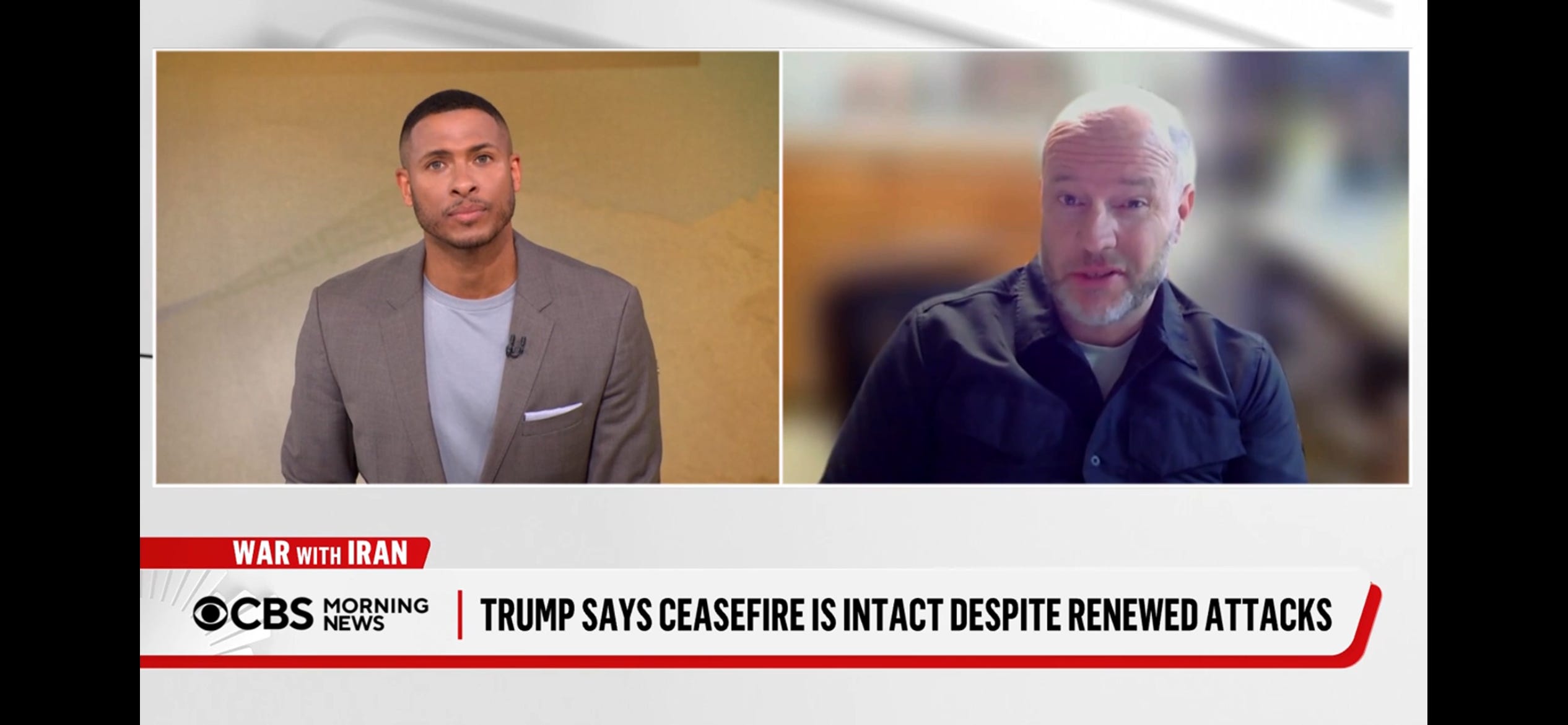
So, rather than write another full essay on the Strait of Hormuz, the blockade, Project Freedom, and the ongoing diplomacy, I thought it might be useful to show some of the prep behind the recent interviews for CBS and NewsNation. This is less a finished argument than a look at how I have been trying to translate the written analysis into usable words.
The core frame has been relatively consistent:
We are not at a military stalemate. We are at a commercial and political stalemate. The United States can move warships. Iran can keep commercial shipping uncertain. Those are very different things.
That distinction matters because the U.S. military problem, while difficult, is still manageable. The United States can escort, overwatch, strike, defend, interdict, and move naval forces through the Strait. But reopening Hormuz is not the same as moving U.S. destroyers through it. Reopening Hormuz requires commercial confidence. Shipowners, insurers, flag states, and crews have to believe the route is usable. Hormuz may be open on a map. It is functionally closed if commerce will not move, as it has been since the beginning of March.
That was one of the main points I prepared for CBS. There had been reporting that the United States cycled two destroyers into the Gulf, and later that three had transited out. Without ship names and more detail, I did not want to overstate the significance. Still, it was notable because it was the first reporting I had seen of U.S. Navy vessels leaving the Gulf since the conflict began. That may suggest the United States is resetting posture or managing force flow. But the larger point remained the same: a military reset does not solve the commercial problem. Moving Navy ships is not the same as restoring confidence for merchant shipping.
That same logic carried into the NewsNation prep. The question was whether three days without ships transiting the Strait meant we had reached a true stalemate. My answer actually tied back to the onset of the conflict. It is not that the Strait is physically impassable. It is that the commercial system does not trust it. A route can exist, escorts can be available, and warships can be present, but if owners, insurers, flag states, and crews do not believe the route is usable, then commercial shipping will not normalize. Particularly when there is still violence among combatants, or when the US is striking Iranian ships that look a lot like the same ones we want to go through, except under a different flag. That is where the Iranian strategy matters.
For decades, we have described Iran as an asymmetric threat. Now we are seeing what it means to threaten asymmetrically. Iran could never defeat the United States with conventional power, and it likely never intended to. The aim is not to defeat the U.S. Navy. The aim is to keep uncertainty alive around Hormuz long enough that Washington, markets, regional partners, and diplomats all feel the pressure.
That is asymmetric coercion.
Iran has already absorbed a massive application of U.S. force. Threats of more strikes may not meaningfully change Tehran’s calculus if it believes its strategy is working: endure punishment, preserve leverage, and force pressure back into diplomacy. That is why the White House’s threats have not changed Iran’s stance. From Tehran’s perspective, pain is not failure if the pain preserves leverage. The Strait is not just a waterway. It is Iran’s primary bargaining chip.
If Iran can make Hormuz unsafe, it can affect energy markets, regional partners, commercial shipping, insurance markets, and U.S. domestic politics without winning a conventional military fight. That is the shift. The conflict may have begun with stated goals around Iran’s nuclear program and regime behavior, but the Strait has become the mechanism through which Iran can apply pressure back on the United States and the global system.
That is also why escorting ships through Hormuz is not maritime traffic control. It is a military operation through a contested chokepoint. It involves destroyers, ISR, air defense, helicopters, mine-countermeasures, communications, route guidance, rapid response, and the constant management of ambiguity. The vulnerable platforms are not the destroyers. They are the big, slow merchant ships that need predictable, charted water. That distinction matters. A U.S. destroyer is built for risk. A tanker or LNG carrier is not.
The ceasefire is under the same kind of strain. It may still exist politically, but militarily both sides are testing its edges. The United States is trying to preserve pressure without fully returning to major combat operations. Iran is trying to keep the Strait uncertain without triggering the full weight of the U.S. response. Every transit, every threat, every kinetic response changes the status quo by design or by default.
The phrase that has become important to me: by design or by default.
Military actions are shaping the political environment, whether we intend them to or not. They may be designed to apply pressure to the diplomacy underway. Or they may simply be having that effect without being fully thought through. Either way, the report card will be political. That brings us back to the blockade.
One of the questions this morning was about the reported CIA assessment that Iran can withstand months of blockade before facing a crisis severe enough to affect regime decision-making. That should not surprise us. A blockade is basically a naval siege, and sieges take time. Iran’s ability to absorb economic suffering has been conditioned by decades of sanctions, isolation, smuggling networks, and adaptation. The Iranian population will endure the pain long before the powers in Tehran feel compelled to shift course. That does not mean the blockade is irrelevant. It means we should be sober about what it can and cannot do.
A blockade can impose suffering quickly. It does not necessarily compel decision quickly. That is why the off-ramp matters. The blockade only makes sense if it creates leverage for a negotiated settlement. If it becomes a substitute for diplomacy, then the United States is sustaining economic disruption, military risk, and political pressure without a clear strategic payoff. That is the thread tying these hits together: the military instrument is real, but it is not self-validating. It has to support a political outcome.
The military problem is manageable. The commercial and political problem is harder. The question is not whether we can keep pressure on Iran. The question is whether that pressure is moving us toward an outcome.
For me, the prep has been the useful part. The television segments are short, and sometimes the best argument only gets one sentence. But the discipline of preparing for them forces clarity. What is the central distinction? What is the phrase that survives contact with the anchor’s question? What is the point that can be said in twenty seconds without turning into mush?
This week, the answer has been fairly simple:
The military instrument shapes diplomatic efforts. By design, or by default.
Iran is sticking to its asymmetric strategy, and views it as being effective.
The question for the United States is whether our use of force is producing leverage toward an outcome, or simply reinforcing the contest Iran believes it can sustain.
That is my weekend update.