
Wither, or Whither, Cuba?
Creating Chaos without the constraint of Analysis

6 May 2026
A colleague recently asked for my thoughts on Cuba. My initial reaction was blunt: we are still midstream in Venezuela and Iran, and neither has produced a clean or controlled outcome. That alone should sober anyone treating Cuba as the next logical domino in a sequence of U.S.-driven realignments. We have a chronic habit of confusing a regime’s exhaustion with its surrender.
Cuba’s condition is not ambiguous. The country is in sustained economic decay, facing chronic energy shortages, and losing its youth at scale through emigration. These are indicators of state fragility, but they are not indicators of political malleability. Fragility suggests a vessel is ready to break; it does not suggest it is ready to be poured into a new, American-shaped mold.
U.S. policy continues to rely on coercive pressure—a bet on managed collapse. The logic holds that if we sufficiently degrade the regime’s resources, we can force a pivot toward U.S. interests. This approach has been the default setting for decades. It has not produced a transition; it has produced endurance, adaptation, and a persistent narrative within Havana that internal repression is a necessary defense against external siege. Recent sanctions have again been framed by the regime as collective punishment, which reinforces the very power structure we intend to weaken.
Any argument that more of the same will now produce a different outcome requires a rigorous explanation. What has changed in the structure of the Cuban state, its security apparatus, or the population’s tolerance for hardship that would make a collapse more favorable to U.S. interests today than it was twenty years ago? Moreover, what plan do we have for success should our initial aim bear fruit-will we backfill across sectors to rebuild Cuba or is it simply a case of starting something with no plan for the consequences?
The current conversation is inevitably shaped by ideology and diaspora politics. The Cuban exile community brings legitimate moral authority regarding the regime’s behavior. However, we must distinguish between their lived trauma and their strategic forecasting. There is a recurring belief that sufficient pressure will produce not just a breakdown, but a restoration aligned with U.S. preferences. That belief is not supported by the historical record of state breakdown, nor by Cuba’s own history of defiance. Those of us observing from the outside should apply the standard intelligence caveat: listen to the advocates, weigh the passion, but do not mistake aspirations for ground truth. Desire to influence here transcends informing.
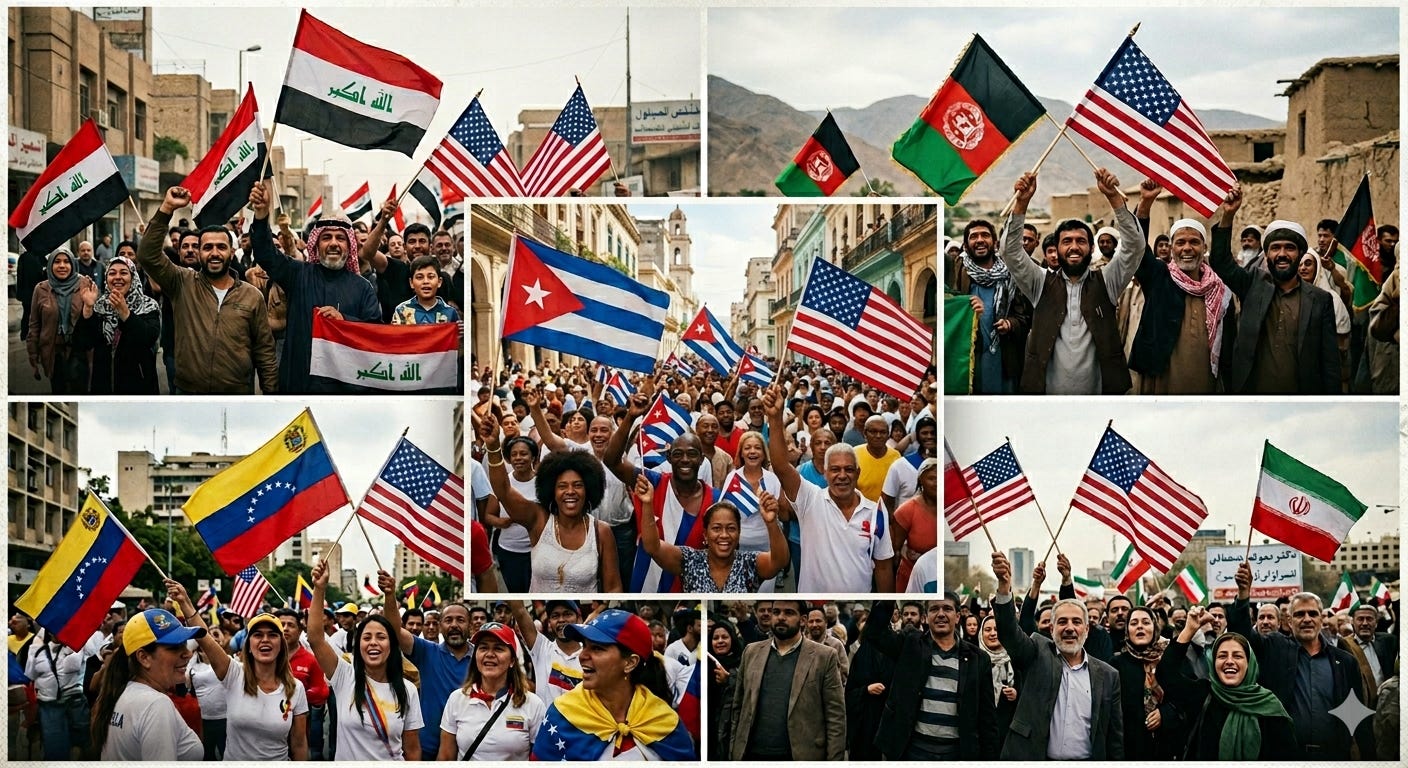
This pattern is not unique to Cuba; it is the same script we see in Venezuela and Iran. There are individuals and factions in every repressed society who would welcome U.S. intervention, but that should not be mistaken for a national posture. None of these societies is collectively waiting to be saved. While many citizens may not mourn the demise of their leadership, the brief euphoria that follows American action tends to evaporate the moment structural realities and local resentments reassert themselves.
What we consistently underestimate is the friction produced by decades of U.S. pressure. Sanctions and regime-change rhetoric do not vanish into thin air just because a government is corrupt. Two things can be true at once: a regime can lack legitimacy, and a population can still deeply distrust the United States’ intentions for their future.
Weak states under sustained pressure do not reliably transition into aligned partners. They fragment. They export instability, empower informal black markets, and generate mass migration. In Cuba’s case, that last effect is already a daily reality. Given our geographic proximity, the United States does not watch a Cuban collapse from a distance; we bear the immediate, domestic consequences of it.
Too often, shallow analysis points to Vietnam, Japan, or Germany as evidence that former adversaries can be flipped into partners. This is lazy history. Japan and Germany were rebuilt following total war, physical occupation, and a massive, multi-decade commitment of American blood and treasure. Vietnam normalized through a slow, sovereign convergence driven by shared geopolitical interests against a rising China. None of those cases suggest that remote-control economic strangulation will produce a clean, friendly transition on American terms.
The underlying fallacy in the current rhetoric is that proximity confers leverage. It does not. Proximity ensures exposure to outcomes; it does not ensure control over them.
Cuba, therefore, is not a latent strategic gain waiting to be unlocked. It is a near-field instability risk. Treating it as an opportunity for coercive realignment reflects a misunderstanding of both the island’s internal dynamics and the historical performance of our own policy tools. We have spent decades applying pressure in Cuba, and we are actively applying it in Venezuela and Iran, without producing the clean, controlled outcomes often assumed at the outset. Before extending that model yet again, the burden is not to argue that Cuba is vulnerable. It is to demonstrate, credibly, that this time the result will be different—and why.
You struck a nice balance here, Sir. I would only add a piece of information about Cuba's current situation. Unless Cuba finds another sponsor soon, it's economy will completely collapse. This is different from the crisis following the fall of the USSR. Then, Cuba still had some industrial base and a lot of political capital among the population. Now, both are depleted. Hopefully, there is some post regime strategy in Washington. Rubio knows Cuba better than any previous State Secretary, however his bias towards the Cuban-American view could create some friction with reality.
Great article Ray.